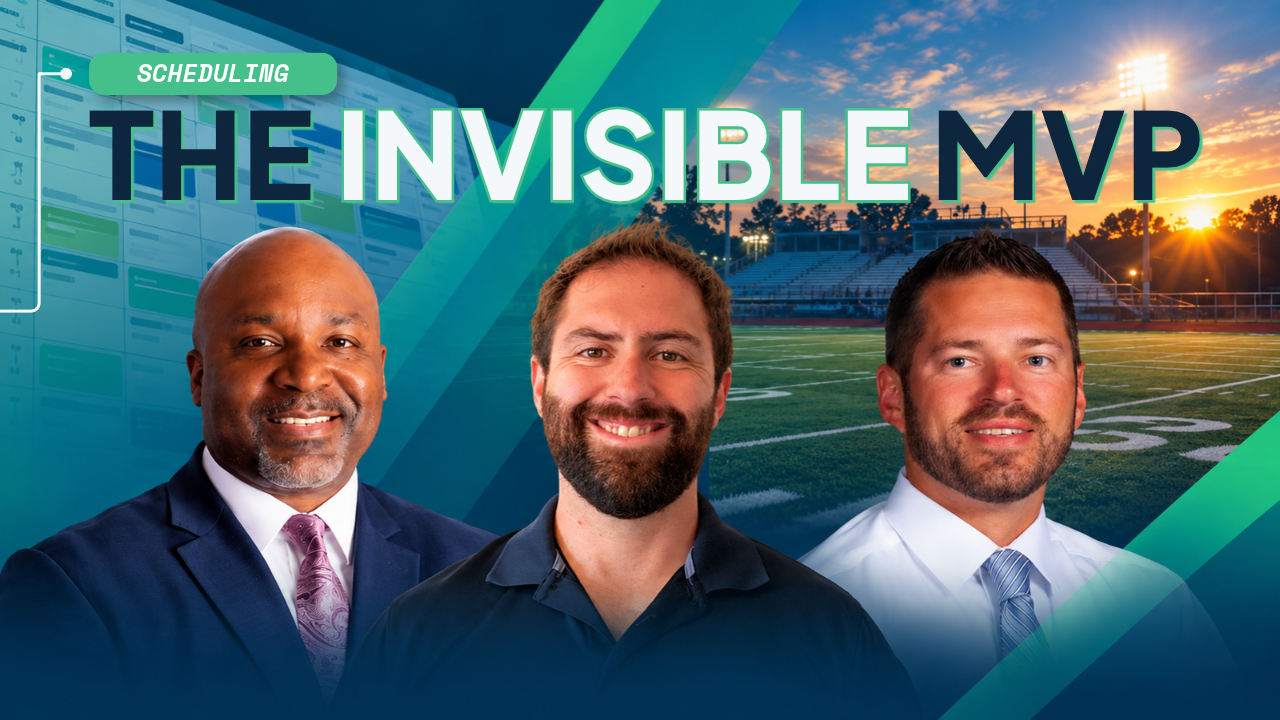

Over the last three parts of this series, I've shared what our panel had to say about the hardest parts of being a new athletic director, the turning point that gets you from surviving to actually leading, and the advice we'd each give our younger selves if we could.
There's one thing I haven't addressed head-on: why our ADs left the chair to be a part of Bound.
I'll be honest — we noticed the irony ourselves. Here we are, telling you how much longevity in this profession matters, and every one of us walked away from it. So I asked the group directly: why?
"I don't think I left athletic administration"
Keith Badger's answer has stuck with me since. He pushed back gently on the idea that he'd left at all. "I don't think I left athletic administration," he said. "We left the chair — we didn't leave the mission."
Keith compared it to the jump he made years earlier, from head coach to athletic director: he loved having an impact on his team, and becoming an AD let him have that same impact on an entire school. Moving to Bound was the same kind of step up.
"We left the chair — we didn't leave the mission."
"Now I get to work with tons and tons of ADs and figure out ways to serve them and advance the profession," he said. He's not sitting in an AD chair anymore — but the people who are still sitting in those chairs are, in his words, "the most important people." This is just a different way to serve them.
Kevin Fitzgerald felt the same pull. "That passion didn't stop," he told us. "It's still there in the morning when we get up."
He just gets to show up for schools across entire states now instead of one building.
Solving problems is still the job
Brian Petersen framed it in a way that resonated with me as a fellow former Iowa AD: "I think we're solutions people. We don't try and create problems — we try and solve problems. ADs do all of that in the background."
Moving to Bound, for him, was a chance to keep doing exactly that, just at a bigger scale.

Kolleen Nesheim admitted something a lot of us feel: you miss it.
"It's in our blood," she said. "It's a passion." But she also told a story that captures why her work at Bound still scratches that itch.
She'll schedule a call with an AD to talk about registration, and within minutes they're talking about youth night, or which weather app they use, or what snacks the officials actually like.
"It just gets you back into it," she said. "I'm pretty lucky to have that opportunity to keep working with high school athletics."
Kevin Simmerman brought a book into the conversation — From Strength to Strength, about finding purpose in the second half of your career — and connected it to something we all know: the average tenure of an athletic director is one to three years.
His question wasn't how do I get out. It was: how do I take everything I learned in 29 years and use it to help someone else stay in this profession longer?
"This is the best profession I think you could ever be in," he said, "because we've already talked about the impact we get to have on others."
Why this matters to us at Bound
Here's what I keep coming back to: this entire webinar happened because Keith shared an article about AD turnover in the first three years, and it struck a nerve.
This isn't just a talking point for us — it's something we've all lived.
And that's exactly why we believe in what we're building at Bound. We know firsthand what it's like to spend your day worrying about tickets, buses, officials, and schedules, when what you actually got into this profession for was building relationships — with your coaches, your parents, your community.
Our goal is to help take the first list off your plate so you have more room for the second one. Not because the administrative side doesn't matter, but because it shouldn't be the only thing you have time for.
If any part of this series sounded familiar — if you've felt that exact tension between managing the day-to-day and actually leading your program — we'd love to talk. You can reach us any time.
Thank you activity and athletic directors for the work you do every day: for your kids, your coaches, and your community. Most of it happens in the dark, where nobody sees it.
We see it. Keep going.