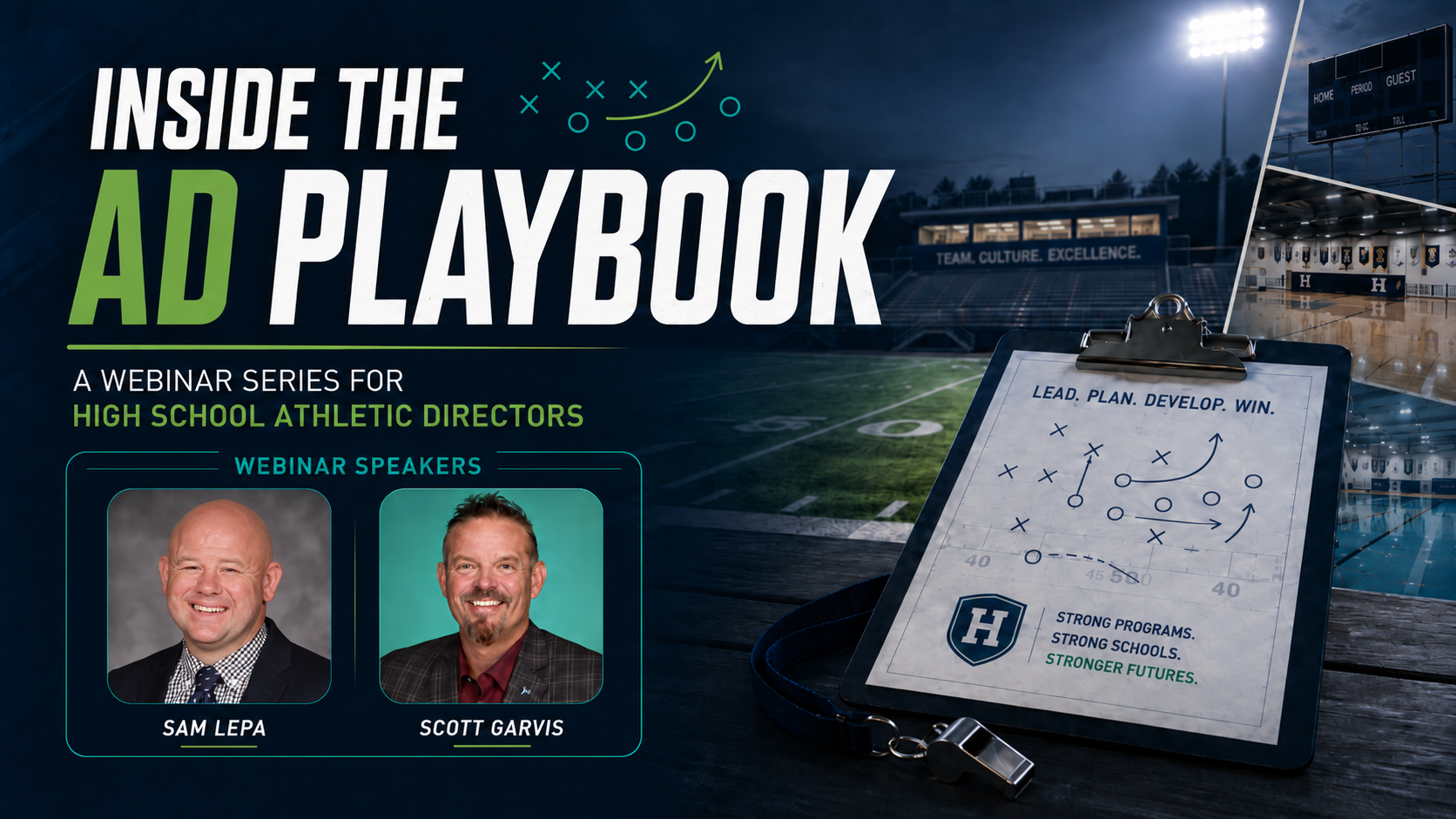

Sam Lepa and I have known each other for a long time now — long enough to watch his career move from northeast Iowa, to Minnesota, and now three years into building something new in South Carolina. So when Sam joined me for "Inside the AD Playbook," it felt less like an interview and more like catching up with an old friend who happens to be really good at his job.
We got into a lot — purpose, problem-solving, leading change, innovation. Here are three parts of that conversation worth passing along.
1. Managing well is itself an act of service
I asked Sam what he thinks the real job is, underneath the schedules, the officials, the logistics. His answer reframed the "boring" parts of the job as the whole point, not a distraction from it.
"Viewing that as an act of service and doing that well for your coaches, I mean, when they can just show up and coach kids and serve kids and lead kids, that's really our role," he said. Doing the managerial work well isn't beneath the job, according to Sam — it's the part that makes everything else possible.
He was just as direct about the stakes of skipping it. "You can't make an impact on a kid's life if they don't have officials for their game," he told me, adding that a program will "lose all of that credibility if you're not running things well."
For a new AD especially, doing the mundane stuff well isn't a detour from real leadership. It's the price of admission.
2. The mark of a high performer is who they've built up
Sam's definition of a high-performing AD has nothing to do with personal output. It's about capacity, and specifically whether you're building it in other people.
"You can't do this on your own. You just can't," he told me, adding that he's watched too many first-year ADs try to grind their way through it solo instead. Telling themselves "I just gotta work 90 hours a week and that'll happen" is not the way to a sustainable AD career.
"I think your high-performing ADs build capacity amongst other people."
His own goal is different. "I want to be an ad for, for decades, not months," he said. That only works if he's constantly developing the people around him.
He credits his mentor, Jamie Sherwood, for showing him what that looks like at scale. Sherwood was an AD of over 25 years who, as Sam put it, "just built people" — to the point that his program produced what Sam calls a whole "tree of legacy" of coaches who became athletic directors themselves.
Sam's since been challenged by his own superintendent with a pointed question he says he now sits with regularly: who are you training that would replace you? "It doesn't mean you're going somewhere tomorrow," Sam explained, but it forces real intentionality about who gets your time and trust.
3. Let the people you serve tell you what to fix
When it comes to identifying problems worth solving, Sam doesn't guess. He asks the students directly. Every athlete gets a department-level feedback form at the end of their season, and Sam is careful about what it isn't.
"This is not program feedback," he said. "This is not, how did you feel about the play call on third and three in week seven." Instead, the questions are personal and simple — did you feel seen, did you feel heard, what is something the AD can do
Coaches are usually wary of it at first, worried it'll turn into a complaint session about them. Sam's found the opposite is true.
"It was amazing, the positive feedback that I was able to give our coaches," he said, "like, look at what this kid said about how you made them feel."
A lot of the fixes it surfaces are refreshingly small, too. Sam recalled getting notes as simple as a request to post the schedule at 7 a.m. instead of 3 p.m. so parents could actually see it. "And it's like, oh duh, that makes sense," he said.
Once he has that kind of feedback, Sam brings bigger changes to a quarterly coaches' leadership council — coaches who opt in are paid a little for their time and get a real say before anything rolls out. The goal isn't unanimous agreement, according to Sam. It's making sure everyone feels heard on their way to being aligned.
What running the department looks like day to day
Sam values the management aspect of the job — but that doesn't mean you have to go it alone. Sam's advice: "I think you've gotta create systems so people can feel comfortable stepping in and helping you with those tasks, because they've got to get done. You have got to have that credibility of doing your managerial stuff well, and that's where finding systems that can help comes in."
In his experience, the right systems and right tools together start stacking up benefits the whole program can see. "I truly have done this with and without Bound, and us adding that into the system this year has made it easier on our bookkeeper, it's made it easier on our administrative assistant, it's helped us with concessions and making that easier. And that just gives you bandwidth, because you can't constantly be pouring out without anything coming back in. So I would say finding systems to help you, because all of those things in today's world have been automated for you — you've just got to find the right partner that's out there."
Sam was candid about what's actually freed up his time this year. Chasing down game workers used to eat entire days. "I would tell you, I spent hours and hours and hours chasing down game workers," he said. "And that system of just sending out the link and getting them to sign up — oh, that was a godsend." Now the online sign-up handles reminders and payment questions on its own, and as Sam described it, his secretary "knows exactly who to pay, how much... it's all right in front of them."
You have to have credibility of doing your managerial stuff well, and that's where finding systems that can help comes in...Adding [Bound] into the system this year has made it easier on our bookkeeper, our administrative assistant, with concessions...that just gives you bandwidth, because you can't constantly be pouring out without anything coming back in.
A similar story played out with a rained-out summer camp. Rescheduling used to mean, in his words, "finding emails and trying to find a sign up on an Excel sheet." This time, using Bound's camps feature, it took a fraction of the effort.
"It took me two minutes and I typed it in there and it sent a text, an email notification," Sam said, and according to him, not a single kid showed up to the old time slot.
One thing to take with you
None of what Sam described is complicated. It's treating the unglamorous parts of the job as real leadership, building people instead of hoarding control, and asking the students you serve what's actually working. As Sam and I wrapped up, his ask was simple — don't try to adopt everything at once. Pick one idea from this conversation and apply it in your own program this week.
Go deeper
This only scratches the surface. Sam also walked through how his Den Builder booster program grew local sponsorship revenue 30% in its first year, and why he thinks high school athletics might be one of the most under-tapped marketing platforms in local business.
Want the full conversation? Watch the on-demand webinar: Inside the AD Playbook — 5 Things High-Performing South Carolina Athletic Directors Do Differently, with Sam Lepa.