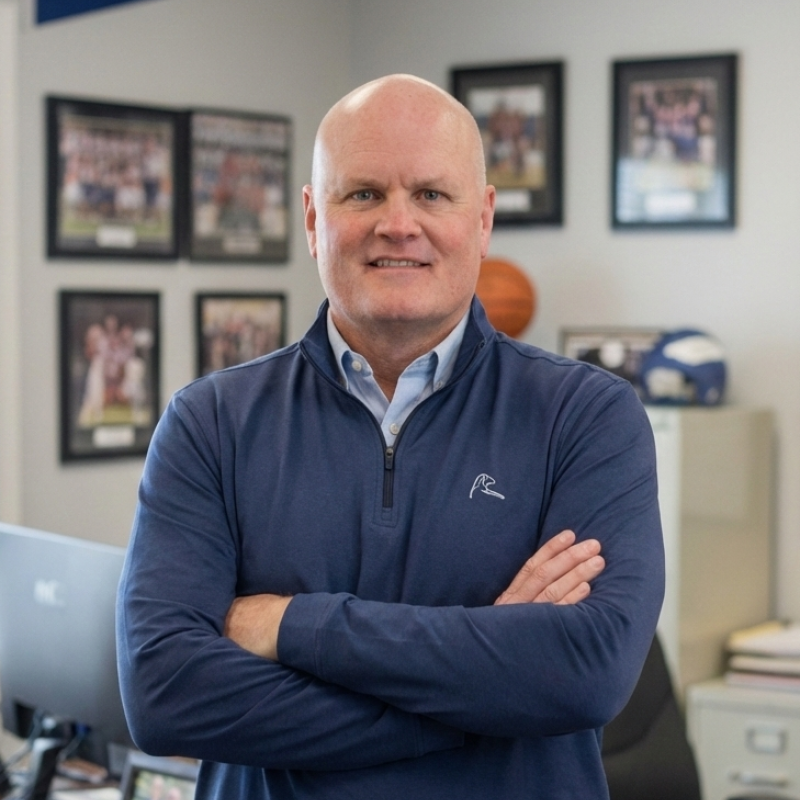
Brian Carver is the Athletic Director at Enka High School in Buncombe County, is a CMAA, an NCADA Athletic Director of the Year, and a recipient of the NCHSAA's Dave Harris Athletic Director Award of Excellence. He's also the first to tell you how he got there wasn't easy.
Brian joked that he's a fairly decorated administrator "not because I was good, but because I was horrible." He acknowledges his mistakes, and that he had to learn from them. "And I got better along the way," he said.
That's the right kind of honesty for an "Inside the AD Playbook" conversation. Here are some highlights from our conversation that covered purpose, problem-solving, leading change, and innovation.
Get out from behind the desk
When someone hands a new AD "the keys to the kingdom," Brian told me, the natural move is to prove you're up to the job by knocking out the to-do list. He lived it.
When he took over 25 years ago, the department was $35,000 in the hole. He spent a lot of time behind a computer screen doing forensic accounting and building a budget.
"I got us $35,000 out of the hole," he said. "But I didn't fulfill my full potential as a leader because I didn't involve my other folks. I stayed in my office too much and concentrated too much on those tasks."
When I asked him what the job really is, he started with something he got wrong. Not a bad hire or a failed policy, but a habit. When he first took over, he stayed behind his desk.
I had my own version of that moment. Early in my career, a longtime AD who'd become my principal found me at my desk lining up buses and event workers and told me to get out and watch practices. I thought he was crazy. It turned out to be some of the best advice I ever got, and Brian agrees.
"I think that's the missing ingredient to it all, is creating those relationships," he said. The real payoff is trust.
The first time you pop into a coach's office, he explained, they'll assume they've done something wrong. "The more you're out there and do it, the more they get comfortable with it and they realize you're not there to say 'I'm watching you.' You're there as kind of a mentor role," explained Brian.
"You've got to get out of your office. You've got to go create relationships and trust among the people that you lead."
Even after 25 years, Brian told me, not getting out to more practices is still his biggest regret as an administrator. He's honest that it's hard to pull off, but his advice is plain.
"You've got to get out of your office," he said. "You've got to go create relationships and trust among the people that you lead."
He also recommends putting that time on the calendar, with regular one-on-one meetings with head coaches, assistant coaches, and a couple of athletes you trust — not necessarily the most popular kid.
What he wants ADs to practice most is what he called one of the most underutilized skills of the leader: "That's listening. We got two ears and one mouth for a reason."

Listen before you rule, and roll change out slowly
That habit of listening shapes how Brian handles problems.
"When you listen to your folks, they'll tell you what you need to know," he said. "If you listen to your athletes, they'll tell you what you need to know."
He cautions against the reflex to issue a ruling or point to page five of the policy manual before you understand the root of the issue.
A parent demanding a coach be fired, for example, isn't automatically the real problem.
"Just because a parent emails you and says we need to fire this guy doesn't make it an automatic problem or situation," Brian said. "Identifying what the real issue is is crucial."
Is it a coaching problem, a leadership problem, or a communication problem?
"If you stay in the leadership position long enough, change is inevitable. It's like the tide. You ain't holding it back."
He's also wary of being the only voice in the room. "It's hard to put yourself in a situation where you go, I'm the judge, jury and executioner on everything that goes on," he said. The more people you involve in deciding how to move forward, the more buy-in you'll get.
The same thinking guides how he leads change. "If you stay in the leadership position long enough, change is inevitable," Brian told me. "It's like the tide. You ain't holding it back." What matters is how you bring it in.
Brian leans on a small leadership team, and he was quick to say he doesn't mean a committee. "I'm talking like three to five trusted members of your coaching staff," he said, plus an administrator or two to bounce ideas off. You can float something early and ask whether people are going to freak out.
He pointed to his department's strategic plan as an example. When he handed it to his coaches, they were skeptical. "You ought to have seen the looks on their faces," Brian said. So he walked them through it. There were six bold steps, he told them, and steps one through four, plus part of five, were already in place from the past year.
"While it looks huge on paper, we're already doing it," he said. "The sixth one's the one that's going to take us some time...but we don't get to six if we don't accomplish the other five."
His formula for change fits in two words. "Systematically, slowly," he said.
"You roll it out over time, and you involve other people in the planning process, so that it doesn't come at them as a punch in the face all at once."
Ask students what's missing, then act on it
When I asked Brian what he's proudest of in 25 years, he didn't have to think about it. It's the Student Athlete Advisory Committee at Enka. He got the idea while serving on the NCHSAA Board of Directors, where he saw students in real leadership and mentoring roles on the state committee.
"That is some really cool stuff," he remembered thinking. "We don't have that at our school."
Nobody in his area had one. His superintendent made Enka the pilot, and once it was running, the model spread across Western North Carolina to about 35 or 40 high schools that hadn't had a committee before.
"They all said we feel undervalued as athletes. We don't feel appreciated. They pointed out things that my blind eye never saw before."
The payoff came fast. Brian surveyed the athletes on the committee and asked what the number one issue at their school was that they could correct right away.
"They all said we feel undervalued as athletes. We don't feel appreciated," he said.
That stung, because those same athletes were on the announcements every day and in the local news. But when he walked the hallways with his student officers, "they pointed out things that my blind eye never saw before."
Many teams didn't have a designated locker room, or any space to call their own.
So Enka took about nine spaces that used to be broom closets and remodeled the athletic department. Every team got its own locker room and every coach an office, even if they had to share it. The point, Brian said, was making everyone feel like they mattered.
"You're the JV cross country runner as a ninth grader, but yet you have a place, you have a role here and you're part of our family," he said. "That would have never happened had I not had the student athlete committee and put out that survey."
Make the decision and find a way
I asked Brian what he'd say to an AD who wants to do something like that but is stuck in the daily grind. His answer was simple: "Make the decision to do it."
"If it's important enough to you, you will find a way to do it," said Brian. He acknowledged some of the hesitation is fear, whether that's lack of support, funding, or help. But you won't know what you can accomplish until you take the first step. "You would much rather try and fail than never try at all."
Brian also protects 30 minutes every morning to read, because he can't expect to become a better leader without it. He hands routine tasks to his assistants so he has room for bigger projects.
That's also why I keep coming back to systems. The buses, the game workers, and the schedules are exactly the work that can crowd out the projects Brian is describing. Taking it off your plate is how you buy back time for the people and ideas that made you want this job. It's what we're trying to help ADs do at Bound.
Brian left everyone with one more reminder, and it might be the most important one. It's easy to get siloed in this role and feel like you're in the hole by yourself.
"You're not alone, folks," he said.
Hear the rest from Brian
This is just a slice of a much longer conversation. Brian also talked about the $3.5 million field house he's working to build at Enka, how he's handing off routine tasks to free up time for bigger projects, and why he's determined to help more ADs stay in the job past the early years.
Want the full conversation? Watch the on-demand webinar: Inside the AD Playbook — 5 Things High-Performing North Carolina Athletic Directors Do Differently, with Brian Carver.